
Flashlight Comparison Testing?
You light up my life... (Part 1)

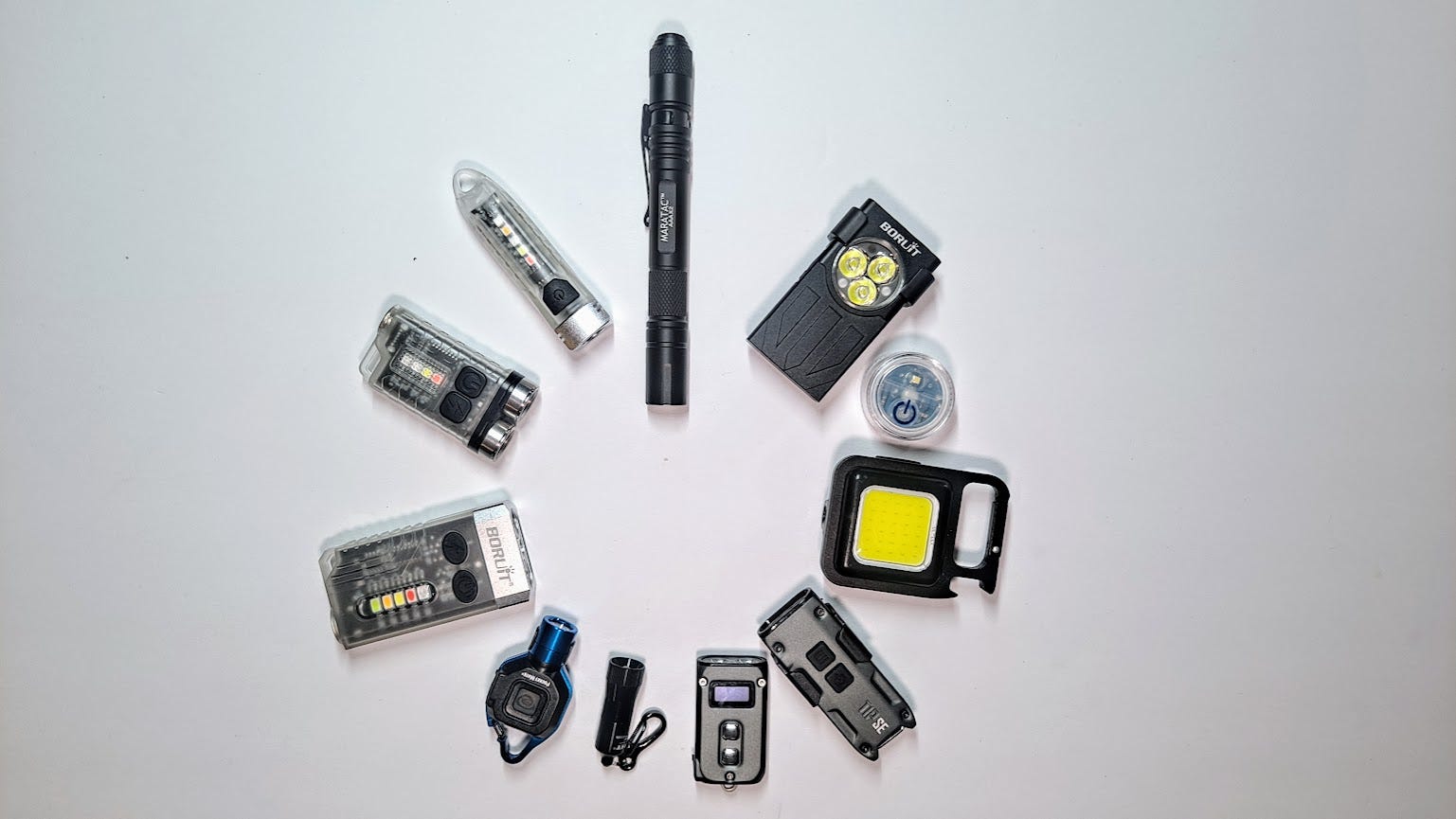
Links to all lights in the picture will be linked at the bottom of this page. All links are affiliate links unless noted otherwise.
Introduction:
On my YouTube channel (My Channel), I do a large amount of flashlight reviews lately, as that is what my subscribers have been interested in. But I have run into a problem that may not bother some channels, but it bothers me. I’m finding it difficult to fairly compare like brands and even different brands. The regular way people compare flashlights is body color, battery type, and lumens. Lumens being the most important for most people.
What is a lumen?
A lumen is the unit of measure of luminous flux. Essentially “a measure of the total quantity of visible light emitted by a source per unit of time” per Wikipedia. Sounds easy enough, right? Then why do so many companies seem to have arbitrary lumen ratings, when most are no where near actual value? The short answer is money.
Money?
What does money have to do with it? Lumens is a selling point. Irregardless of its actual value, the higher the lumens the higher the sale price. There is no standard price per lumen, and without science lab access, the amount of variables that effect light output is significant. How can I reliably and accurately compare flashlights?
Variables?
There are a host of poor man (me), non-scientific variables to contend with. Including but not limited too: Range, lux, hot-spot, beam pattern, diode type, LED driver type, voltage, reflector, lens size and type, air temperature (as colder air temps allow an improvement to lumen output as it is less stressful to the LED driver).
I’m probably over thinking this, but I like data. And as such, accurate, reliable, and repeatable data. Now I’m sure if I can figure out a series of tests, the 1st dozen or so flashlights can be tested in a series. But I need to make sure that all new flashlights after that are appropriately tested to the same standard. So, in theory, the more of this I hash out now, the better the data set.
So flashlights are one thing, but what about lanterns? I have reviewed a couple of lanterns so far, so how do I test omnidirectional light output? Do I separate LED lanterns from gas lanterns?
Then what about alternative source lights, like those that rely on solar, wind or water? Maybe, since I’ve only done one solar light, maybe I can leave that for another day.
Whats the current plan?
I suppose the first step is to list all the attributes to compare like stated lumens, stated range, battery voltage, battery type (maybe voltage vs mAh), type of reflector, weight with and without battery (if battery is not built in), hotspot clarity, type of LED if stated, range, etc…
Next, I suppose a non-white tarp/sheet, with a set of cross-hairs per say, to aim the flashlight at, say 1 meter away, to see how the focus of the light is. With this same test, I can check for any lighting anomalies, like poor beam pattern, multiply hot spots, etc… The reason for not using a white tarp/sheet, is due to the reflection, it may blur, or hide issues with the beam pattern.
Next I suppose I can figure out range. I could set the lights on a level platform outside, aiming towards several staked boards, maybe in 10 foot intervals, or 25 foot intervals. I was thinking maybe a total of 100 meters, but that’s 328 feet, but I don’t think I have access to any unobstructed fields that is 328 feet long. Maybe I should start with 100 feet or 30.5 meters, and see how that works out. Two of the flashlights in the picture at the top are rated above 500 meters or 1600 feet, which seems outrageous for a small edc (every day carry) light. So if either of those “500” meter flashlights cannot illuminate a target 100 feet away, then we know those rating are bupkis.
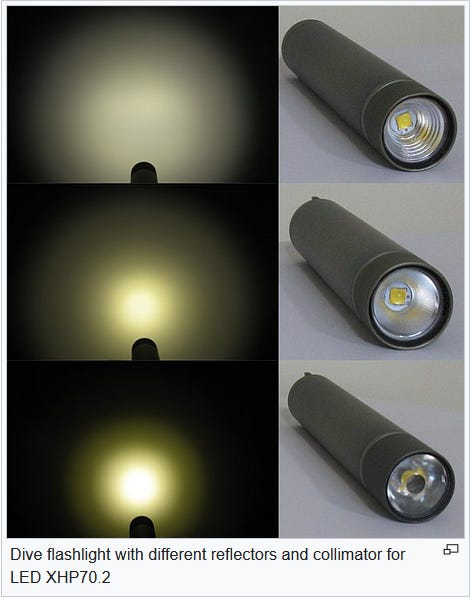
Picture above is owned by AlbDRina, CC BY-SA 4.0 <https://creativecommons.org/licenses/by-sa/4.0>, via Wikimedia Commons.
So doing a deep dive into range for a flashlight, there is a formula D=SQRT(Q/E)
Where D is the Optical Distance (m)
Q is the quantity of light emitted (lumens)
E is the light intensity (lumen/m^2)
Source: Lumens distance calculator
I’m curious though if this is actual range, or or an estimated range.
What about Lux?
Lux was explained well by Nitecore , and thus I quote it here:
Lux is a proportional measurement that calculates the amount of light on a particular surface. You usually won’t see this measurement when discussing flashlight brightness specifications because lux is affected by the distance the illuminated surface is from the light source. As the distance increases, the overall lux decreases. Since flashlights are designed to be carried and not in a fixed position, we can go ahead and disregard lux.
So the good news, its one less attribute I need to figure out how to compare.
The end:
This is the end of this section (part1) about flashlight comparisons. If anyone has some insight on how I can fairly compare lights on my channel, I’m all ears. Any help would be greatly appreciated.
Top picture, Clockwise starting at the long inspection light at the top:
Here are all the links for the title picture, they are all affiliate links which means there is no price difference, just I may get a small commission percentage if someone buys something through the links. I may explain affiliate links in detail in a later post. There is however a 10% discount using a coupon code SURVIVALGYVER on the Maratac AAAx2 flashlight, or your entire order on www.countycomm.com